Showing posts with label Gujarat. Show all posts

Friday, August 15, 2014

Missing cub traced, may find new family soon

The cub that had gone missing ever since the body of his mother was shifted from the forest has been traced and is under constant watch by the department. The cub will soon find a new family.
At present the cub is showing signs of post traumatic syndrome and running away from foresters. It was doing so even on seeing Rana Madi, who was led to the dead mother by this 18 – month old cub. Officials following the developments said they want to cage the cub and carry out a health check before allowing it to move around on its own or be released in another group.
IMG_3668
On Saturday, foresters had the carcass of an 11- year old lioness, who had been gored to death by a buffalo herd. The carcass was found by a beat guard who had been led to the dead mother by an 18- month old cub.
Forest officials were surprised by this unprecendented incident, which was confirmed by the postmortem report. the postmortem pointed to the lioness having multiple fractures in her ribs and that she had died of an intestinal hemorrhage.
However, as the cub and mother were alone, the forest department will ensure a safe release of the cub in another group. “ we have in the past carried out such safe releases and orphan cubs have been accepted. The release is mostly done in groups that have cubs of the same age, so that the orphan is easily accepted”, says deputy conservator of forests Anshuman Sharma.
He said that the dead lioness had two cubs, one of which had died seven months ago.
“The department has identified a couple of groups in Khambha and Jambudi area and once the cub is caged it will get a safe monitored release in one of these groups,” said Sharma.
The officials said the department was observing the behavior of the groups identified before the cub can be released.
Courtesy - Times Of India 

Rare Masked Booby spotted near Mahuva ( Bhavnagar, Rajkot, Gujarat, India )

The bird is usually found in tropical zones

Manoj Sanghediya, a 23-year old amateur bird watcher from Datardi Village in Mahuva taluka of Bhavnagar District ( Rajkot, Gujarat, India ), could not identify the large seabird that had fallen in his farm on Saturday.
But he was quick to rescue the sick bird that was unable to fly and take it to Mahuva Town. An environment activist, he often rescues snakes in his village.
masked booby in Mahuva
The bird that he rescued was Masked Booby, a large bird found in tropical zones of theoceans.
“When the Masked Booby was brought on Saturday, it was sick and exhausted. We contacted, Dr. Nayan Patel, a veterinary doctor, who earlier worked with forest department in Mahuva advised us to give glucose to it. We tried to save the rare visitor but it died on Tuesday evening”, said a wildlife activist from Mahuva Chirag Koradiya.
Bird conservationists say that the Masked Booby may have been exhausted and landed in the coastal area in a sick condition. It nests on small tropical islands especially without forests. It breeds in central and western pacific as well as off Mexico.
According to experts, Masked Booby are spectacular divers that can plunge diagonally into the ocean at high speeds. They mainly eat small fish.
“This could be the third time that a Masked Booby was reported to be seen on the Saurashtra coast,” Koradiya said.
Courtesy - Times Of India 
Saturday, January 11, 2014

Ahmedabad has 160 bird species

The ornithologists as a part of the animal Bird Race event organized jointly by Natural Heritage Conservation Society ( NHCS ) – Gandhinagar and international bank identified only 160 bird species in and around Ahmedabad city. 
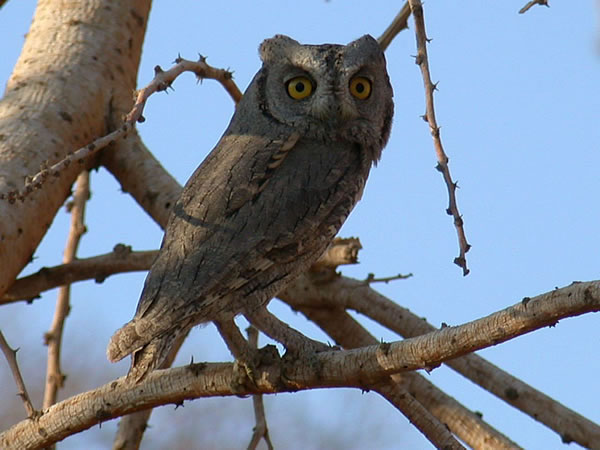
species-Otus-brucei-4
Last year the same even had identified over 260 bird species. This was the seventh time such an event was held in Ahmedabad in which around 140 participated in group of 40 teams. More than 160 species of bird were recorded during around the city.
Each team spent its entire day watching birds in and around Ahmedabad with their own tally of species. Earlier bird races in Ahmedabad have recorded more than 260 species of birds. These teams moved around at a critical point on the avifaunal migration route, and flanked by a vast landscape of open habitats, from agricultural tracts to semi –arid landscapes, inland wetlands and secondary growth, and area with human population.
storks There were no pre – determined routes to the Bird Race – participants observed the birds at multiple locations all within 30 – 40 km radius of the city. According to Virag Vya, a research coordinator NHCS, Ecologists Irshad Theba and Bharat Jethva during the race the team identified rare species which included White Stork, Short – eared Owl, Red Avadavat ( Red Munia ), Booted eagle were sighted by different teams.
The coordinators said that the programme helped to create awareness and conservation ethos among the citizens. The participants were also sensitized towards the bird injuries during Uttarayan.
Courtesy:- Times Of India

Dholera ( Gujarat, India ) SIR ( Special Investment Region ): Campaign to save Bhal ( Bhavnagar, Gujarat, India ) ecology launched

Wildlife activities from Saurashtra opposing the proposed Dholera Special Investment Region ( DSIR ) project have undertaken a letter writing campaign, raising concerns about the threat propsed to the ecology and biodiversity of Bhal region.
Chill out for Bird Watchers
They are posting letters to top shots in Union environment ministry, Ahmedabad collector, officials of environment and forest department in Gujarat and prominent wildlife conservationists across Indian raising their concerns.
Last week, Gujarat Pollution Control Board ( GPCB ) and Ahmedabad district collectorate held a public hearing on environmental impact assessment on the proposed DSIR. The site for the proposed DSIR is a rural area of approximately 920 square kilometers, comprising 19 villages of Dhandhuka taluka and three villages of Barwala taluka in Ahmedabad District.
“the areas where DSIR is proposed is unique grassland having rich bio diversity. The proposed DSIR is just 600 meters away from the Blackbuck National Park, which is a habitat of endangered species like lesser floricans, harriers, wolves and hyenas among others. The highest density of wolves in the country is in Bhal area. Moreover, the Blackbuck National Park in Velavadar is world’s largest roosting site for harriers. Out of 16 harrier species in the worl, at least four species of Montagu, Pallid, Eurasian Marsk and Hen are found here. All these aspects need to be takes care of. Hence, we are writing to the concerned authorities,” president of Dharamkumarsinhji Nature Conservation society in Bhavnagar Dr IR Gadhvi said.
He added that Bhal is of the 17 important bird areas in the state indentified by Indian Bird Conservation Network besides being the largest breeding ground for lesser floricans.
Activists claim that the ecological zones of Blackbuck National Park and proposed DSIR over lap at places which is very worrying.
“All wildlife conservationists and environment activists from the state are concerned over the adverse impact the DSIR will have on Bhal region, which is the wheat bowl of Gujarat. We want that this project should not be cleared without addressing these concerns. We will also write to National Wildlife Board for its intervention,” a wildlife activist from Bhavnagar Shrenik Shah said.  
Courtesy:- Times of India 

Monday, December 9, 2013

4th Global Bird Watchers' Conference from January 31, 2014

The 4th Global Bird Watchers' Conference, the annual event of Gujarat tourism department in coordination with forest department will be held for three days, from January 31.
To put water bodies in the state on the international map and attract tourists, Gujarat Tourism Department in association with various organization began this event in 2009-10 and it has become a regular event.
Officials said Gujarat is emerging as an eco-tourism destination; being host to wide range of pristine and hitherto unexplored destinations for nature lovers. The conference will not only showcase the destinations of Gujarat; but discussions will also be held on how to preserve these winged visitors who are facing many threats.
Officials said the objectives of the fourth conference were to promote Gujarat as a birding destination and project it as a eco-tourism destination. The conference aims to provide a platform for discussion by international experts on birds, birding and bird watching to promote tourism and conversation.
Also, the conference will discuss on the migratory route of birds from Europe and West Asia to the coasts, wetlands and islands in Gujarat. Officials said, that this time, the focus is likely to be Nal-Sarovar and nearby areas as the water body was recently declared a Ramsar site.
For Details contact, 00-91-281-2465237 || 00-91-281-2483878

Caracal trapped in gando baval (Prosopis juliflora) rescued

The forest department rescued a female carcal (a wild cat known for its reclusive behavior) that had got trapped in gando baval weeds ( Prosopis juliflora ) in Jatavira Village of Nakhatrana taluka in Kutch district ( Gujarat, India ) on November 23. This is perhaps the first instance of a caracal being rescued after it got struck in wild weed.
Caracal, Felis caracal, Augrabies Falls National Park, N. Cape, South AfricaCaracals usually venture out of their lair at night. There are around 50 of them in the state and are found only in Kutch. One of these wild cats was last spotted by the officers of the Gujarat forest department in 2006. The conservator of Forests D.K. Sharma said that the rescued caracal was female and around three years of age.
When the rescued animal was found on November 25th had injuries on its front left feet. “ On getting information about it, officials rushed to the spot. After clearing the bushes, the caracal was brought to Nakhatrana ( Kutch, Gujarat, India ) for veterinary care. The services of two expert veterinary doctors were taken to cure the animal,” said Sharma. He further said that the animal had got stuck in thick thorny dry bushes while trying to capture a prey.
Deputy Conservator of Forests Pravinshinh Vihol said that the species is considered rare in India. It has also been listed in annexure – 1 of the CITES (‘Convention on International Trade in Endangered Species of Wild Fauna and Flora’, also known as the Washington Convention) and is also a schedule - ` animal under the Wildlife Protect Act.
According to Dr. Naveen Pandey, veterinarian f the Corbett Foundation who treated the rescued animal, said the paw of the caracals’ lift forelimb, had mild abrasion between the second and third fingers of the toe.
Courtesy: - Times of India

Tuesday, September 10, 2013

Lioness Laxmi’s lucky five in Zoo

Three Year Old Mother in Gir (Junagadh, Gujarat, India) has Given birth to a Record litter, all the cubs are healthy 


Five seems to be the lucky number for Laxmi. This three year old lioness in Gir (Junagadh, Gujarat, India) has given birth to a litter of five. Interestingly, Laxmi herself was one of a litter of five born to lioness named Shyama.
At her age, Laxmi should usually be learning the tricks of hunting, but she is already a mother and playing the role with tremendous ease. She is taking good care of the cubs and is protecting them from all kinds of threats of jungle life.

IMG_3693
On May 17, 2013, Laxmi gave birth to five cubs in Gir Interpretation Zone at Devaliya (Sasan Gir, Junagadh, Gujarat, India). The cubs are now 75 days old and weigh between 3.5 and 4 kg. The cubs have begun to supplement the mother’s milk with meat as they have already developed teeth. “This is a remarkable feat as normally a lioness gives birth to 2 to 3 cubs and it is rather rare for all the cubs to survive. Laxmi deserves praise for her mothering skills well proved by the thriving brood,” said a forest officer.

Gujarat’s chief wildlife warden C.N. Pandey said, “Laxmi has inherited good genes. She was born on May 3, 2010, at Sakarbaug Zoo, Junagadh (Gujarat, India) to lion Daksh and lioness Shyama. However, her mother Shyama could raise only three of them. The rest died in their infancy. Laxmi has been able to achieve a record”.

“A lioness can feed only four cubs at a time. But Laxmi has been able to work around this biological limitation. 

This example illustrate that Asiatic lions are genetically strong and competent,” said Pandey. “The forest department continues to play a leading role in biodiversity conservation through dedicated management and support to nature with skill care. It is crucial that each and every individual of an endangered species is protected with proper skills and capability”.

“Birth to five cubs in a litter is extremely rare,” an official of the department said.

“We were not sure if Laxmi would be able to raise all five cubs. But she was to make a record in the known history of Asiatic Lion management. Laxmi, supported by the forest department staff, she has been able to ensure that all of her survive,” the official said.

Courtesy:- Times of India

Gujarat readies to clone its Lions

Sets up DNA Banks to preserve and improve Gene pool

Like humans, Asiatic Lions now have a gene bank with a cloning facility. In collaboration with the Gujarat State Bio-Technology Mission (GSBTM), the forest department has already collected 80 strains of DNA of the Asiatic lion.
IMG_3670
The DNA banking of lions will not only be useful for further diseases and management related issues, but will also help to have healthy lion genes. An exclusive “Institute of Wildlife Genomics and DNA Banking” will be set up by the end of this year.

Akshaykumar Saxena, the GSBTM Director, says, “The institute is a joint collaboration of the forest department and the GSBTM, and will come up in Gandhinagar(Gujarat). We are already working on the project”.

The institute will help the department to overcome fears that the genes of the lions are deteriorating, as the institute will have a data bank of genes of different types of lions in Gir Region (Gujarat, India). Having lineage data will help the wildlife experts evaluate breeding stress and diseases susceptibility, say officials. The DNA bank will also have embryo transfer technology to supplement highly endangered species.

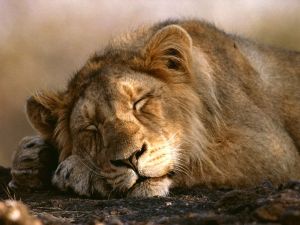
asian-lion-sleeping_452_990x742An official says, “The institute will help identify the cats with the best genes, which will be introduced at the gene pool centre set up at Sakarbaugh Zoo (Junagadh, Gujarat, India) and Rampara Virdi (Rajkot, Gujarat, India).

Once the institute is fully operational, various studies related to diseases and other management aspects of lions will be taken up. The genetic material stored in these banks will be used to increase genetic diversity. Material from DNA banks can be used to infuse small populations with new genetic material, increasing their chances of survival. Another goal of DNA banks is to increase the population size.

In 1999, at the Audubon Center for Research of Endangered species a domestic house cat gave birth to an African wildcat kitten that had been frozen as an embryo in a DNA bank. This was the first example of inter species birth. In 2000, the Center produced test-tube Caracal cats from sperm that had been stored in their DNA bank.

Officials say that the GSBTM is also in the process of collecting samples of cubs born at Rampara virdi (Rajkot, Gujarat, India) to study their genes. The GSBTM also plans to carry out a study of the Pestes Des Petits Ruminants Virus (PPRV).
Courtesy:- Times of India

Friday, July 26, 2013

Translocation animals outside home turf is high risk :- IUCN

New Guidelines May Hinder MP’s Lion Shifting Plan


The latest guidelines of the International Conservation of Nature (IUCN) on translocation of wildlife could prove to be a major roadblock for Madhya Pradesh’s lion dreams. The world’s oldest and most trusted global environment organization says shifting animals outside their indigenous range “is high risk”.

The guidelines, issued on July 12, warn, “There is a high risk of failure if the species originate from environments markedly different to the destination area. The risk is accentuated by the fact that the animals may be poorly adapted to the destination area”.

Gujarat has resisted Madhya Pradesh’s demand for Gir Lions for the past decade. The Supreme Court (Indian) had ordered translocation of lions to the Kuno Palpur sanctuary in its Aril 12 order after which Gujarat has filed a review petition.

Under the guidelines, shifting lions out of Gujarat would be classified as ‘assisted colonization where the species translocated is outside the indigenous range. The guidelines specify, “Translocations of organisms outside of their indigenous range are considered to be especially high risk given the numerous examples of species released outside their indigenous ranges subsequently becoming invasive, often with massively adverse impacts.”
IUCN cautions that suck translocation should be taken up only in cases where the risk is low and that the idea should be abandoned if there is any doubt. “If extinction of the species in the proposed destination area occurred long ago, or if conservation introductions are being considered for the first time, local communities may not develop a contact with a new species new to them, and hence may oppose the move. In such cases, special effort to counter such attitudes should be made well in advance of any release,” the guidelines said.
TOI has regularly reported on how both licensed and unlicensed guns are commonplace in villages around Kuno with the government making no effort to sensitize the people about lion translocation. Besides, in the early 1900s, African lions had been introduced here but the local populace had hunted them out of existence within a year.

The new guidelines say, “Multiple parties involved in most translocations have their own mandates, priorities and agendas, unless these are aligned through effective facilitation and leadership, unproductive conflict may fatally undermine translocation implementation or success.”   

Courtesy:- Times Of India 

Thursday, July 18, 2013

48 lesser floricans counted at Black Buck National Park

Velavadar Grassland is an Ideal Habitat for their Breeding

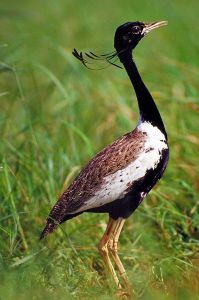
The forest department has counted 48 lesser floricans, the critically endangered smallest bustards od the world. In Velavadar Blackbuck National Park (BNP) in Bhavnagar district. The counting was done on Saturday and Sunday.

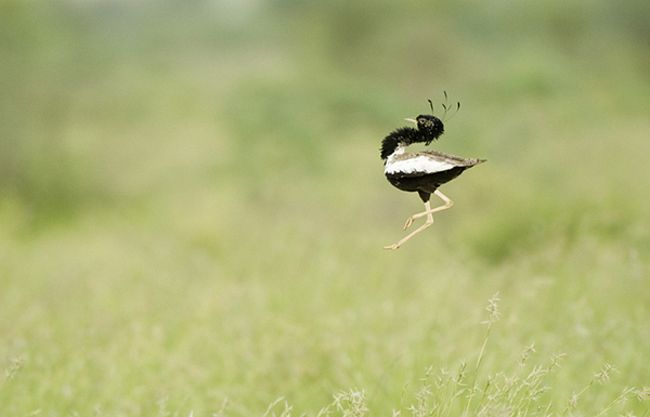
lesser_florican_display5722a
According to assistant conservator of forests, BNP, D.P. Baghela, of the 48, 44 were males and four were females. Forest officials said BNP is the only grassland in north western Indian that has observed a steady population of lesser florican. Last year, 54 were counted here.
“This year we first spotted lesser floricans in first week of July. This grassland provides an ideal habitat for lesser floricans for breeding during monsoon and started leaving before winter,” Vaghela added.
florican1

Lesser florican is endemic to the Indian subcontinent and list under Schedule 1 species under the Indian Wildlife (Protection) Act, 1972.

“Degradation of grasslands in Gondal, Rajkot and Jamnagar earlier attracted lesser floricans. But they are seldom seemed here. Velavadar National Park is the only grassland in north western Indian where floricans are reported in good number, largely due to better grassland management and protection,” he said.Forest officials said earlier, lesser floricans were found in many parts of the region, but now these birds are found at very few places in the state.

Two years ago, researcher G.S. Bharadwaj of Wildlife Institute of India (WII) carried out a study on lesser floricans from across the country. They study observed that most of the potential florican habitat in the state were converted into cotton fields where large quantities of pesticides are being used, the greatest threat to floricans here.

“Lesser florican is best known for the leaping breeding displays by males during the monsoon,” an official said.


Courtesy:- Times Of India. 

Friday, July 5, 2013

Lions should be allowed to migrate naturally, says report

A report submitted by an NGO, Empower Foundation, to the forest department has stated that lions should not be trans-located and the big cats should be allowed to migrate naturally only.

The report has suggested that even if the need arises, the lions should be given a safe passage and should be given a natural corridor to any other place, but they should not be trans-located to Kuno Palpur in Madhya Pradesh, which will result into a failed translocation and extinction of the endangered lions from the new proposed habitat, a big loss to the wildlife.

asian-lion-sleeping_452_990x742
The report has stated that lions are not present only in the Gir National Park, but over a period of time have migrated naturally hundreds of kilometers away to places like Amreli, Savarkundla, Liliya Porbandar, Paniya, Mitiyala, Barda, Una, Chhara, Sutrapada, Babariya, Kodina, Visavadar, Hipavadli, Jamvada, Jasdhar, Girnar, Bhavnagar and Palitana. The 1,412 sq km abode of Asiatic Lions has now spread across 10,500 sq km, thus mitigating concentration rick in one area.

Jalpesh Mehta of Empower Foundation said if an epidemic can kill all lions in Gujarat, it can also kill all the tigers in the Madhya Pradesh, Rajasthan and Maharashtra (Pench-Kanha-Bandhavgarh-Ranthambhor) and south India’s Karnataka – Tamil Nadu  belt (Mudumalai – Nagarhole – Bandipur – Waynad) as the distance is almost similar between Gir and other areas as compared to tiger reserves.

The report has further stated that Gujarat should stop using Gir Lions, in fact the Gujarat Government should communicate that they are found everywhere and should mention lions in Gir, outside Gir or in Greater Gir or Saurashtra region to correct the world’s perception on the issue.

Courtesy:- Times Of India

Sarus cranes flock to Dantiwada Dam(Banaskantha, Gujarat, India)

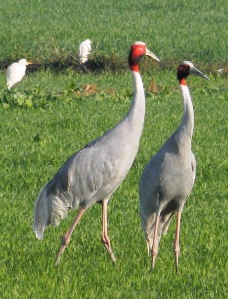
A large number of Sarus crane have flocked to Dantiwada dam site these days much to the delight of bird lovers.

Sarus Pair 003
“I was surprised to see a large numbers of beautiful cranes in the shallow water,” a professor in local R.R. Mehta Science College Dr. Suresh Prajapati said. He added that is was pleasure to see around 70 cranes feeding on fishes.

He said the dam located about 30 km from Palanpur in Banaskantha district (Gujarat, India) is an arid place and these cranes rarely come to such a place.

“In all we counted 73 adult cranes. It indicates that no breeding had taken place here and all had migrated from some other place,” assistant conservator of forests at Banaskantha N.M. Bhatol said. He said, “These birds are placed under a threatened category. It is great to spot them here in the arid land. Millet fields with shallow waters and generation of awareness to some extent has led to these birds arriving here”.

Prajapati pointed that in 2010 he had spotted hardly 10 birds at the site. A bird lover Nirdosh Gupta said Sarus cranes are spotted during pre-monsoon season when the dams having meager water in their shallow bottom are ideal place for picking fishes.

Courtesy:- Times Of India

Saturday, June 1, 2013

Act before it’s too late for Great Indian Bustard, says experts

Conservation portal urges Gujarat CM to take action

Experts and conservationists believe that a project on the lines of Project Tiger has to be launched in order to save the Great Indian Bustard (GIB) that is threatened with extinction.

Prerna Singh Bindra, member of the National Board for Wildlife, said that Conservation India (CI), a wildlife conservation portal, has urged Gujarat Chief Minister Narendra Modi to take immediate measures for conservation of the threatened bustard species. “If action is not taken, this bird could become the first mega species to go extinct in the country since the cheetah. Only a ‘Project Bustard’ can save the species, just as ‘Project Tiger’ did for our national animal”, said Bindra.

According to CI’s campaign paper, “Act Now! Or say Goodbye to the Great Indian Bustard,” there may be less than 200 Great Indian Bustard left in India. In Gujarat, 50 of the threatened bustard species are to found in Kutch.

The bird has already disappeared from more the 90 per cent of its former habitats. “What is worse, the 
meager remaining number is fragmented into small populations across several Indian states, making the bird even more vulnerable to extinction. If urgent and targeted conservations actions are not taken immediately, the bird will almost certainly go extinct within the next decade or two,” says CI co-founder Ramki Sreenivasan.

The Great Indian Bustard (GIB) is found in Rajasthan, Gujarat, Maharashtra, Madhya Pradesh, Karnataka and Andhra Pradesh. The largest population of about 100 birds is in Rajasthan where it is the state bird.
The GIB is threatened with extinction because of the reduction in undistributed arid and grassland (its habitat), degradation of and distribution to its existing habitat, hunting, lack of projection for many traditional “lekking” and nesting sites, and lack of a management and conservation policy for natural grassland.

Apart from these issues, there is lack of cooperation between different departments and stakeholders in GIB habitats. Livestock overgrazing and disturbance by tourists and photographers, especially during breeding season, have also contributed to reduction in GIB numbers.

According to the campaign paper, there is a need for urgent and coordinated actions, including setting up of a secure and fully protected ‘lekking’ sites, where male bustards gather to attract females. Also there is a need to constitute a GIB task force in every state where these birds are to be found.

A full – scale ‘Project Bustard’ on the lines of Project Tiger needs to be launched for the threatened bustard species, conservationists say. The Ministry of Forests and Environment has demanded that the possibility should also be looked into.

Courtesy:- Times of India. 

Sunday, May 12, 2013

No Drought of winged beauties


Despite the erratic rainfall and drying water bodies around the city, there is a silver lining. Ishwaria Lake on the outskirts of Rajkot (Gujarat, India) has literary turned into an oasis for thousands of wetlands birds. Spread over 40 hectares of wasteland at Madharpar village, Ishwaria (Rajkot, Gujarat, India) plays host to thousands of migratory birds from far away places like Siberia and Mongolia in winter and resident birds through out the year. the lake is a major attraction for bird lovers from far and near.

nalsarovar3


nalsarovar33


Courtesy:- Times of India

WORTH Flocking to Thol (Ahmadabad, Gujarat, India)

Paris of Sarus crane beckon bird-lovers.

If you thought, Thol (Ahmadabad, Gujarat, India) was only about migratory birds, another visit to this lake is due!. Flocks of majestic Sarus cranes have descended in the lake and near - by fields. there are at least 50 Sarus cranes here. No wonder then that bird watchers and shutterbugs are flocking to Thol (Ahmadabad, Gujarat, India) these days, braving the blistering heat.


Courtesy:- Times of India


Monday, May 6, 2013

Vulture count on a rise thanks to Asiatic Lions


Vulture population may be on a decline across Gujarat but the number of these fast diminishing scavengers has surprisingly risen in Bhanvnagar (Gujarat, India) and Amreli districts (Gujarat, India). Interestingly, it is the lions that are helping these endangered birds make this region their permanent habitat.

The number of vultures in the 70-km coastal stretch from Mahua-Rajula-Nageshree (Gujarat, India) has steadily increased from an all time low of 87 in 2010 to 134 in 2013. In fact, the extremely rare Eurasian Griffon specie of vultures that were only winter visitors of Mahuva, are now seen throughout the year.  

vul8

Besides serious conservation efforts and people’s awareness, wildlife experts also attribute the increase to the presence of large number of lions in the revenue land in this region. Vultures feast on the animals that have been preyed upon by lions.

“Since these lions are out of forests area, they mostly kill domestic cattle and feed on them in open fields. Moreover, these animals are untreated and not administered Diclofenac, which is the sole reason for vulture’s decline. This helps vultures to have a healthy food chain, a critical aspect for their survival,” said Ruchi Dave, honorary wildlife warden, Bhavnagar district (Gujarat, India).

Recently, wildlife enthusiasts spotted 25 endangered vultures including two Eurasian Griffons, feedin on the carcass left behind by an Asiatic Lion near Rajula in Amreli District (Gujarat, India).

“Few days ago mi spotted eight vultures feasting on an animal killed by Lions. Such a sight is quite common now”. Said Jasubhai Mobh, a Maldhari living in Mobh Nesh near Khambha.

Lions are in good numbers in Mahuva, Rajula, Khambha, Jafrabad and Savarkundla (Gujarat, India) area and most of them are out of protected forest area. “There are over 75 lions in his 70 km area and most of them are in revenue area. We have often seen vultures eating the lion’s kill in these areas,” said Vipul Laheri, honorary wildlife warden, Amreli (Gujarat, India).

Notably, Bombay Natural History Society (BNHS) has selected the Mahuva area as one of the six provisional Vultures’ safe Zone on the country.

Lions’ presence in this ‘vulture’ zone has helped these birds stay put. “Eurasian Griffon vultures have been observed throughout the year, which indicated that this area is non-disturbed habitat for vultures,” Dave said. 

Courtesy:- Times of India. 


Saturday, March 30, 2013

For Saurashtrians(Gujarat, India), “lions are like kin”


The people of Saurashtra(Gujarat, India) take care of lions as they would of their family members. If they spot a lion iIMG_3668n the vicinity of their village, they take pride in the fact and protect it. These statements were made by the government in the assembly for the first time.

Minister of state for forests and environment Govind Patel – in response to a question from Nikol MLA Jagdish Panchal – informed the house that lions were found in many places of India, but they survive only in Gujarat owing to people’s conservation efforts.

“They are the pride of Gujarat and it was only because of the people of Saurashtra that the lion population grew,” Patel said.

“Even if lions attack cattle in villages, the villagers are tolerant of lions”.
Patel told the house that government has also created post of ‘van mitras’ who take care of the animal and keep a watch on the movement inside the sanctuary. He said 898 eco-clubs had been formed in the Saurashtra region.

Responding to a question Patel said that there were 411 lions – 97 males and 162 females – in the sanctuary. He further said that the state had created gene – pool centers. Five new cubs have been born in the last year at the Rampara Virdi centre. These cubs have been born to two pairs of lions captured from completely different areas and brought to Rampara to ensure that the genes different. These centre’s provide a shield against weakening genes of Gir Lions.

For example if the lioness was from Sasan (Gujarat, India), the lion would be from a far off area of Tulsishyam(Jungadh, Gujarat, India) or even Bhavnagar. The minister said that there have been no instances of villagers offering baits to lions in order to show the animals to visitors. However, he admitted that his department had penalized people caught on the spot to the tune of Rs. 93,000 to Rs 31,400.

Courtesy: Times of India.   

Friday, March 29, 2013

Of 92 lion deaths in last two years, 83 were natural


No incident of poaching: Government

A total of 92 lions have died in the last two years in Saurashtra region (Gujarat, India). Of these, 83 died natural deaths while the remaining nine died of accidental causes, like falling into open wells.

Minister of state forest and environmental Govind Patel told the House in a written reply to Lathi MLA Bhavku Unghad’s question. The government said that said that 46 lions each died in the year 2011 and 2012. The minister said that among the dead cats were 43 cubs, 20 males, while the rest were females.
The minister said that there was no incident of poaching in the any part of the state. He added that in 2011 five lions lost like in different kinds of incidents, while the number was four in 2012.

The death of 46 animals was normal as only 11 per cent of the animals are dying annually. The officer said that also there was a drop over the past few years in the number of accidental deaths. The forest department has begun a drive to cover up wells in and around Gir Forest (Gujarat, India). However, such incidents of death due to falling in a well were reported in the areas far away from the sanctuary.

The official added that of one looked at the figure more cubs have died recently. A study by Dr. V. Meena of the Wildlife Institute of India titled “Reproductive Strategy and Behavior of Male Asiatic Lions” revealed that survival rate of cubs was lowest in the first year of birth and gradually increases in second and third year, he added.

Courtesy: - Times Of India

Sunday, March 24, 2013

Gir lioness baby – sits, feeds siblings

In display of Unusual Behavior, introduces cubs to meat early

There’s nothing like a sister’s love. A young lioness, baby sitting her three six – week - old step siblings when the mother is away hunting, has caught the eye of foresters in the Gir Sanctuary(Sasan Gir, Jamnagar, Gujarat, India) .
IMG_3670
Experts say this is a rare sight in the wild – the three year old lioness not only watches over the cubs, but hunts for them as well.  Deputy Conservator of forests, Sandeep Kumar, who is documenting this unique behavior, says generally one and a half month old cubs are not exposed to flesh and blood. “They only survive on mother’s milk”, he says. “But in this case, we noticed that when the mother is not around, the sister not only takes care of the cubs but also gets them fresh meat and they seem to be doing well so far”.

Kumar adds that cubs first taste the meat when they are slightly older. “On a couple of occasions, the sister dragged the kill to the cubs and watched them eat,” he adds. To ensure that this premature weaning does not have any adverse effect, the foresters are regularly monitoring the health of the cubs.
IMG_3700 Even the mother has started hunting closer to home and bringing the kill to the cubs. She makes the kill before the cubs, but ensures that they are at a safe distance, which officials say may be a way of teaching them the first lesions of hunting.

Gujarat additional principal chief conservator of forests, H.S. Singh says, “Usually, the mother would not expose the cubs to blood before 12 weeks. At 12 weeks, they are given their first taste of blood and only after a while are they allowed to eat meat”.

“Lion cubs are nursed till about six months,” says Meena Venkatraman, who has a PhD in lion behavior from Wildlife Institute of India. “They may start to feed on tidbits of meat when the prides are feeding on a kill. This is usually around three months. However, tasting meat is not same as eating meat”.

Courtesy: - Times of India

Sunday, February 24, 2013

Sharp decline in number of vultures, just 1043 left in state


Junagadh (Gujarat, India) Breeding centre starts Delivering results

The government appears to be doing precious little for improving the vulture count in the state. While their numbers have dropped to 1043 which is the lowest count registered so far, the government has so far spent only Rs. 19.70 lakhs for their conservation in the last two years.

The count recorded in 2007 was 2539 and ever since then, there has been a sharp decline. Their number was 1431 in 2008 and 1043 in May 2010.

In written reply to a question from Wakaner (Rajkot, Gujarat, India) MLA Mohammed Javed Pirzada, environment and forest minister Ganpat Vasava said that apart from an awareness campaign to conserve vultures, the government has also started a vulture breeding centre at Sakkarbaugh Zoo in Junagadh (Gujarat, India). In addition to this, the union government has banned the use of Diclofenac treatment by vets, especially on cattle.


Vasava claimed that the centre at Sakkarbaugh Zoo has started showing results in the form of a White Rumped vulture being bred successfully. Two vultures have been born there in the last 2 years.
Officials said that vulture conservation in Gujarat has got a major boost with the Bombay Natural History Society (BNHS) selecting Mahuva (Rajkot, Gujarat, India) and Ahmadabad among the six provisional Vulture Safe Zones (VSZ) in India.

A recent survey has indicated that the current state wide estimated population of ‘critically endangered’ Gyps vultures is 938, White- Rumped vultures is 577 and Long Billed Vultures is 361.


The survey has shown a reduction of 11.34 per cent in the population of Gyps vultures between 2010 and 2013. In 2010, there were 1,065 Gyps vultures. In the survey carried last year, 97 Egyptian vultures and eight Red headed vultures have been enumerated.

Courtesy:- Times Of India (Saturday, 23rd February, 2013).