Showing posts with label Wildlife in India. Show all posts

Friday, July 5, 2013

Lions should be allowed to migrate naturally, says report

A report submitted by an NGO, Empower Foundation, to the forest department has stated that lions should not be trans-located and the big cats should be allowed to migrate naturally only.

The report has suggested that even if the need arises, the lions should be given a safe passage and should be given a natural corridor to any other place, but they should not be trans-located to Kuno Palpur in Madhya Pradesh, which will result into a failed translocation and extinction of the endangered lions from the new proposed habitat, a big loss to the wildlife.

asian-lion-sleeping_452_990x742
The report has stated that lions are not present only in the Gir National Park, but over a period of time have migrated naturally hundreds of kilometers away to places like Amreli, Savarkundla, Liliya Porbandar, Paniya, Mitiyala, Barda, Una, Chhara, Sutrapada, Babariya, Kodina, Visavadar, Hipavadli, Jamvada, Jasdhar, Girnar, Bhavnagar and Palitana. The 1,412 sq km abode of Asiatic Lions has now spread across 10,500 sq km, thus mitigating concentration rick in one area.

Jalpesh Mehta of Empower Foundation said if an epidemic can kill all lions in Gujarat, it can also kill all the tigers in the Madhya Pradesh, Rajasthan and Maharashtra (Pench-Kanha-Bandhavgarh-Ranthambhor) and south India’s Karnataka – Tamil Nadu  belt (Mudumalai – Nagarhole – Bandipur – Waynad) as the distance is almost similar between Gir and other areas as compared to tiger reserves.

The report has further stated that Gujarat should stop using Gir Lions, in fact the Gujarat Government should communicate that they are found everywhere and should mention lions in Gir, outside Gir or in Greater Gir or Saurashtra region to correct the world’s perception on the issue.

Courtesy:- Times Of India

Wednesday, January 16, 2013

Man-eater tigress shot down in Maharashtra


A man-eating tigress was shot dead by a sharpshooter of the C-60 anti-Naxal squad in Navegaon National Park in Maharashtra on Saturday 27 days after it first killed a woman in Bhandara district Gondia district deputy conservator of forests S V Ramarao said the animal was not more than three years old and was shot 20km from the Navegaon National Park boundary The park is 130km from Nagpur.

“We first tried to tranquillize the tigress but missed, and it charged at the team. In panic, one of the commandos, Suresh Atram, fired nine rounds to kill the animal,” Ramarao said. State chief wildlife warden SWH Naqvi had granted permission to shoot the animal on January 4. The elusive tigress had killed a cow on January10 and was in the area. Camera traps were deployed near the cattle kill on Friday to identify it.

At 10am on Saturday a team of 20-25 officials, volunteers and commandos equipped with AK-47s went to check the cameras and established the gender of the big cat. “Presuming that the animal might be somewhere near the kill, we launched a search. One of the commandos sighted the tigress 50 feet away. Assistant conservator of forests Manohar Gokhale fired a dart to tranquillize the tigress but missed. The tigress fried to come closer and a commando then fired in the air,” said Sawan Bahekar, a team member and honorary wildlife warden of
Gondia district. The tigress disappeared after the warning shot. At noon, the teams returned to find that the animal had moved its kill from the original spot. it was then decided that the rest of the team would leave while only seven people — including three commandos — would stay behind in wait of the big cat. Certain that the tigress would return, the team took positions near the kill. At 115pm, the big cat returned. Assistant conservator Gokhale shot a dart but missed. The tigress then came charging at him and commando Atram fired five rounds. Even as the animal got injured, it kept charging. Later, four more rounds were fired after which the tigress finally collapsed.”


Courtesy:- Times of India

Saturday, September 15, 2012

Spoting Wild Tigers at Kanha National Park, Madhya Pradesh, India

In the quiet before dawn, a pale moon still lit the sky above Kanha's (Kanha National Park, Madhya Pradesh) entrance gate. A group of us — 4 Canadians (including Terry and his wife Andy) and I — were en route to Kanha Meadows, a section of the park where we were most likely to see tigers. Upon my inquiry about our chances of spotting a tiger, our forest guard Sadan Yadav replied, “Every minute in the park counts—it only takes a second to see a tiger, so Positive Thinking!” Five hours later, it was almost closing time and still no sign of a tiger. All of a sudden, 3 jeeps roared past us, drivers motioning ahead, ahead! We raced after them and joined the 5 or 6 jeeps parked near a meadow of tall grass.
“There are two cubs in that grass” whispered Yadav. I squinted at the spot but could see nothing. Yadav began to make sharp "tiger" calls. After 5 minutes – a reply!
 
The grass parted magically and there it was — a 16- month old tiger cub!
 
“She thinks it's her mother calling and is replying.”
 
 
And then…another Call!! TWO tigers - the second cub still camouflaged in the grass (see if you can spot it in the left corner)
 
In a breathtaking moment, the cub (if that’s what you call an enormous 16-
month-old female tiger), walked purposefully out of the tall dry grass.
 
 
Sinews rippling gold, her sister dramatically followed her sibling.
 
 
They both vanished once more into the yellow and green grass. How an enormous cat can disappear in an instant (when common sense tells you that it’s still there), is one of nature’s great miracles. “See,” said Sadan Yadav, practically hopping with glee. “Positive Thinking.”
 

Tiger Update

Tiny cub abandoned by mother in Panna
  •  The end of the summer and the beginning of the monsoon always heralds the birth of new tiger cubs. Amidst the flurry of new litters, a female tigress recently abandoned its 20-day old male cub. This tiny youngster was rescued by a highly concerned forest department and revived in an air-conditioned room. It was highly dehydrated at the time of rescue, but we are happy to report that it is now doing well! Since it is being hand reared, however, it will sadly not be able to return to the wild.
 Prominent male tiger passes away in Bandhavgarh
  •  At the end of April, the dominant Bokha male was killed by his son in a ritual fight over territory in the park’s Magdhi zone. The cycle of life and death, however, is unending in the wild, and three females have had litters in the Tala zone, promising lots of action when the park re-opens in October. In June, our naturalists and guests were enchanted by sightings of the Jhurjhura female’s 2-month old cubs. It is extremely rare to see cubs this young, as tigresses tend to hide their cubs in thick undergrowth until they are older and less vulnerable.
 A handful of tigresses with cubs in Kanha
  • Kanha too promises plenty of action next season as a few females have just had litters. Once cubs are older, they start venturing out & there is a good chance of spotting them.

CLICK! Pugdundee Photo Album

Karan Rana shares a few photographs he took last season in Kanha National Park Madhya Pradesh
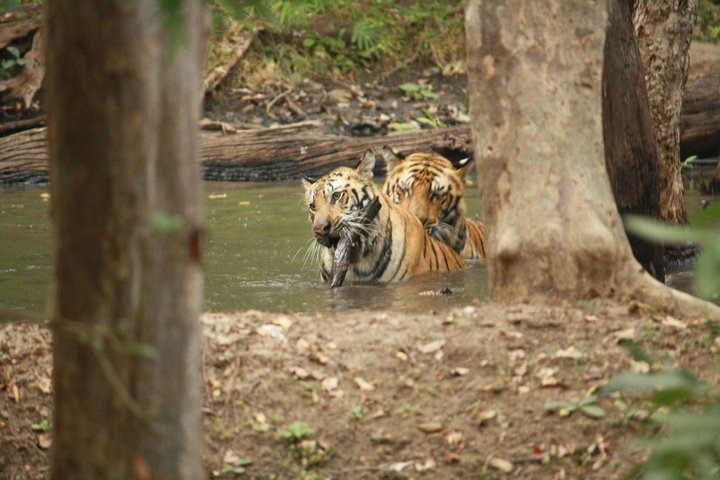
Below Two tigers cool off in a waterhole in Kanha – Photo courtesy of Karan Rana, March 2012


News Courtesy:- Pugdundee News