Showing posts with label Photography. Show all posts

Monday, December 9, 2013

4th Global Bird Watchers' Conference from January 31, 2014

The 4th Global Bird Watchers' Conference, the annual event of Gujarat tourism department in coordination with forest department will be held for three days, from January 31.
To put water bodies in the state on the international map and attract tourists, Gujarat Tourism Department in association with various organization began this event in 2009-10 and it has become a regular event.
Officials said Gujarat is emerging as an eco-tourism destination; being host to wide range of pristine and hitherto unexplored destinations for nature lovers. The conference will not only showcase the destinations of Gujarat; but discussions will also be held on how to preserve these winged visitors who are facing many threats.
Officials said the objectives of the fourth conference were to promote Gujarat as a birding destination and project it as a eco-tourism destination. The conference aims to provide a platform for discussion by international experts on birds, birding and bird watching to promote tourism and conversation.
Also, the conference will discuss on the migratory route of birds from Europe and West Asia to the coasts, wetlands and islands in Gujarat. Officials said, that this time, the focus is likely to be Nal-Sarovar and nearby areas as the water body was recently declared a Ramsar site.
For Details contact, 00-91-281-2465237 || 00-91-281-2483878

Thursday, July 18, 2013

48 lesser floricans counted at Black Buck National Park

Velavadar Grassland is an Ideal Habitat for their Breeding

The forest department has counted 48 lesser floricans, the critically endangered smallest bustards od the world. In Velavadar Blackbuck National Park (BNP) in Bhavnagar district. The counting was done on Saturday and Sunday.

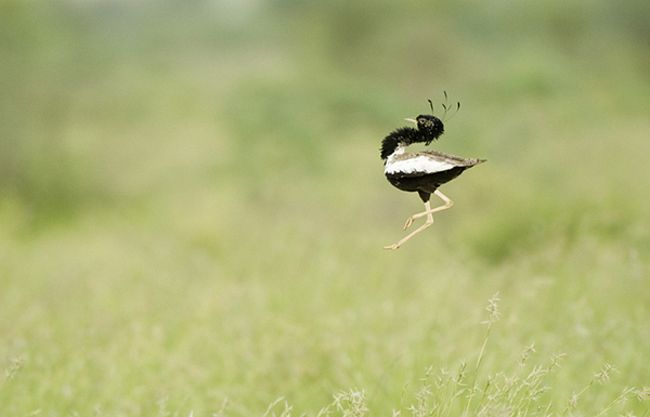
lesser_florican_display5722a
According to assistant conservator of forests, BNP, D.P. Baghela, of the 48, 44 were males and four were females. Forest officials said BNP is the only grassland in north western Indian that has observed a steady population of lesser florican. Last year, 54 were counted here.
“This year we first spotted lesser floricans in first week of July. This grassland provides an ideal habitat for lesser floricans for breeding during monsoon and started leaving before winter,” Vaghela added.
florican1

Lesser florican is endemic to the Indian subcontinent and list under Schedule 1 species under the Indian Wildlife (Protection) Act, 1972.

“Degradation of grasslands in Gondal, Rajkot and Jamnagar earlier attracted lesser floricans. But they are seldom seemed here. Velavadar National Park is the only grassland in north western Indian where floricans are reported in good number, largely due to better grassland management and protection,” he said.Forest officials said earlier, lesser floricans were found in many parts of the region, but now these birds are found at very few places in the state.

Two years ago, researcher G.S. Bharadwaj of Wildlife Institute of India (WII) carried out a study on lesser floricans from across the country. They study observed that most of the potential florican habitat in the state were converted into cotton fields where large quantities of pesticides are being used, the greatest threat to floricans here.

“Lesser florican is best known for the leaping breeding displays by males during the monsoon,” an official said.


Courtesy:- Times Of India. 

Saturday, September 15, 2012

Spoting Wild Tigers at Kanha National Park, Madhya Pradesh, India

In the quiet before dawn, a pale moon still lit the sky above Kanha's (Kanha National Park, Madhya Pradesh) entrance gate. A group of us — 4 Canadians (including Terry and his wife Andy) and I — were en route to Kanha Meadows, a section of the park where we were most likely to see tigers. Upon my inquiry about our chances of spotting a tiger, our forest guard Sadan Yadav replied, “Every minute in the park counts—it only takes a second to see a tiger, so Positive Thinking!” Five hours later, it was almost closing time and still no sign of a tiger. All of a sudden, 3 jeeps roared past us, drivers motioning ahead, ahead! We raced after them and joined the 5 or 6 jeeps parked near a meadow of tall grass.
“There are two cubs in that grass” whispered Yadav. I squinted at the spot but could see nothing. Yadav began to make sharp "tiger" calls. After 5 minutes – a reply!
 
The grass parted magically and there it was — a 16- month old tiger cub!
 
“She thinks it's her mother calling and is replying.”
 
 
And then…another Call!! TWO tigers - the second cub still camouflaged in the grass (see if you can spot it in the left corner)
 
In a breathtaking moment, the cub (if that’s what you call an enormous 16-
month-old female tiger), walked purposefully out of the tall dry grass.
 
 
Sinews rippling gold, her sister dramatically followed her sibling.
 
 
They both vanished once more into the yellow and green grass. How an enormous cat can disappear in an instant (when common sense tells you that it’s still there), is one of nature’s great miracles. “See,” said Sadan Yadav, practically hopping with glee. “Positive Thinking.”
 

Tiger Update

Tiny cub abandoned by mother in Panna
  •  The end of the summer and the beginning of the monsoon always heralds the birth of new tiger cubs. Amidst the flurry of new litters, a female tigress recently abandoned its 20-day old male cub. This tiny youngster was rescued by a highly concerned forest department and revived in an air-conditioned room. It was highly dehydrated at the time of rescue, but we are happy to report that it is now doing well! Since it is being hand reared, however, it will sadly not be able to return to the wild.
 Prominent male tiger passes away in Bandhavgarh
  •  At the end of April, the dominant Bokha male was killed by his son in a ritual fight over territory in the park’s Magdhi zone. The cycle of life and death, however, is unending in the wild, and three females have had litters in the Tala zone, promising lots of action when the park re-opens in October. In June, our naturalists and guests were enchanted by sightings of the Jhurjhura female’s 2-month old cubs. It is extremely rare to see cubs this young, as tigresses tend to hide their cubs in thick undergrowth until they are older and less vulnerable.
 A handful of tigresses with cubs in Kanha
  • Kanha too promises plenty of action next season as a few females have just had litters. Once cubs are older, they start venturing out & there is a good chance of spotting them.

CLICK! Pugdundee Photo Album

Karan Rana shares a few photographs he took last season in Kanha National Park Madhya Pradesh
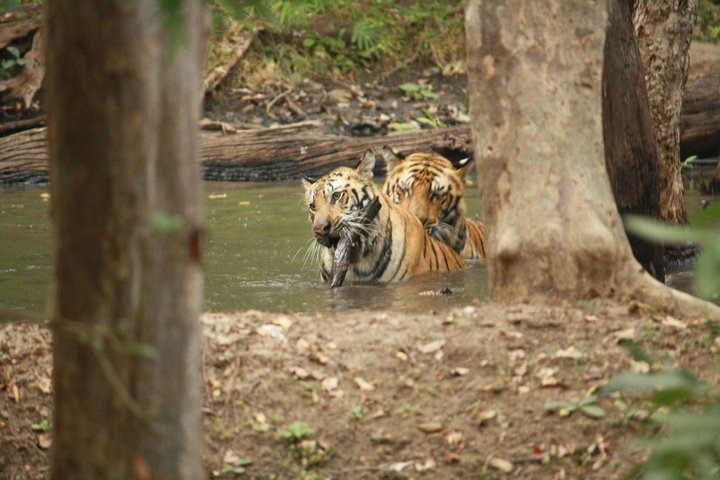
Below Two tigers cool off in a waterhole in Kanha – Photo courtesy of Karan Rana, March 2012


News Courtesy:- Pugdundee News