Showing posts with label Adventure Holidays. Show all posts

Sunday, December 15, 2013

Great India plan for Bustard

A recovery strategy will be drawn up

Ministry of Environment and Forests (MoEF) had directed Gujarat, Madhya Pradesh and Rajasthan to have state – level recovery plans for the great Indian Bustard.
Gujarat principal chief conservator of Forests C.N. Pandey said, “We had met experts recently and have now prepared a draft report, which has been approved and is in the final stages”.
GIB
The MoEF had directed all bustard range stages to prepare state – level recovery plans to conserve the species. The proposed plan will aim at long – term conservation of both bustard species in Kutch in Gujarat. With this state-level initiative, it is expected that the conservation of and habitat restoration of Great Indian Bustard (GIB) will get a boost.
Officials in the Bombay Natural History Society (BNHS) said many vital and bio-diverse habitats such as grasslands and species inhabiting the Great Indian Bustard continue to remain neglected.
Officials said grasslands have been threatened for long from rising human pressures on the habitat, indiscriminate grazing outside traditional grounds, poaching, urbanization and several other factors. Several flagship grassland species of birds and animals including GIB, Lesser florican, chinkara, fox and wolf have been affected in various parts of their former range including Kutch (Gujarat, India). According, to BNHS, the Great Indian Bustard are found in six states in India currently and have populations of GIB and Lesser Florican in Madhya Pradesh, Maharashtra, Karnataka, Gujarat, Rajasthan and Andhra Pradesh. In case of Madhya Pradesh, at present there are two sanctuaries for GIB and two for Lesser florican. In Maharashtra, the few remaining GIB are to be found at some locations in districts such as Solapur and Chandrapur. The situation in other Bustard range including Gujarat is also a cause of concern.
It is worth recalling that experts involved in the conservation of GIB had meet chief minister Narendra Modi and urged him to act and take measures to conserve the bird. According to experts GIB is facing threat through the reduction in the extent of undisturbed arid and grassland habitat, degradation and disturbance to existing habitat, hunting, lack of protection for many traditional “lekking” and nesting sites, lack natural grassland conservation in management and policy. Apart, from these issues there is lack of cooperation between departments and stakeholders in GIB habitats. Livestock overgrazing and disturbance by tourists and photographers, especially during the breeding season, have led to the reduction in the bird’s number.
 Courtesy: - Times of India  

Saturday, March 30, 2013

For Saurashtrians(Gujarat, India), “lions are like kin”


The people of Saurashtra(Gujarat, India) take care of lions as they would of their family members. If they spot a lion iIMG_3668n the vicinity of their village, they take pride in the fact and protect it. These statements were made by the government in the assembly for the first time.

Minister of state for forests and environment Govind Patel – in response to a question from Nikol MLA Jagdish Panchal – informed the house that lions were found in many places of India, but they survive only in Gujarat owing to people’s conservation efforts.

“They are the pride of Gujarat and it was only because of the people of Saurashtra that the lion population grew,” Patel said.

“Even if lions attack cattle in villages, the villagers are tolerant of lions”.
Patel told the house that government has also created post of ‘van mitras’ who take care of the animal and keep a watch on the movement inside the sanctuary. He said 898 eco-clubs had been formed in the Saurashtra region.

Responding to a question Patel said that there were 411 lions – 97 males and 162 females – in the sanctuary. He further said that the state had created gene – pool centers. Five new cubs have been born in the last year at the Rampara Virdi centre. These cubs have been born to two pairs of lions captured from completely different areas and brought to Rampara to ensure that the genes different. These centre’s provide a shield against weakening genes of Gir Lions.

For example if the lioness was from Sasan (Gujarat, India), the lion would be from a far off area of Tulsishyam(Jungadh, Gujarat, India) or even Bhavnagar. The minister said that there have been no instances of villagers offering baits to lions in order to show the animals to visitors. However, he admitted that his department had penalized people caught on the spot to the tune of Rs. 93,000 to Rs 31,400.

Courtesy: Times of India.   

Saturday, September 15, 2012

Spoting Wild Tigers at Kanha National Park, Madhya Pradesh, India

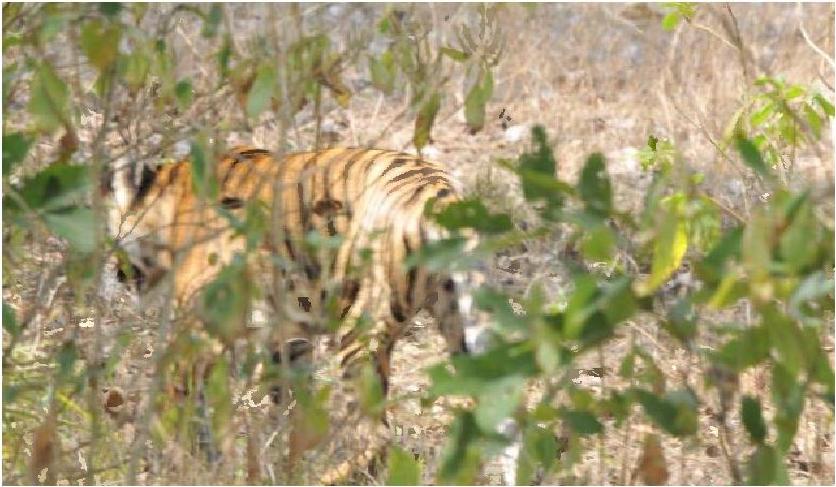
In the quiet before dawn, a pale moon still lit the sky above Kanha's (Kanha National Park, Madhya Pradesh) entrance gate. A group of us — 4 Canadians (including Terry and his wife Andy) and I — were en route to Kanha Meadows, a section of the park where we were most likely to see tigers. Upon my inquiry about our chances of spotting a tiger, our forest guard Sadan Yadav replied, “Every minute in the park counts—it only takes a second to see a tiger, so Positive Thinking!” Five hours later, it was almost closing time and still no sign of a tiger. All of a sudden, 3 jeeps roared past us, drivers motioning ahead, ahead! We raced after them and joined the 5 or 6 jeeps parked near a meadow of tall grass.
“There are two cubs in that grass” whispered Yadav. I squinted at the spot but could see nothing. Yadav began to make sharp "tiger" calls. After 5 minutes – a reply!
 
The grass parted magically and there it was — a 16- month old tiger cub!
 
“She thinks it's her mother calling and is replying.”
 
 
And then…another Call!! TWO tigers - the second cub still camouflaged in the grass (see if you can spot it in the left corner)
 
In a breathtaking moment, the cub (if that’s what you call an enormous 16-
month-old female tiger), walked purposefully out of the tall dry grass.
 
 
Sinews rippling gold, her sister dramatically followed her sibling.
 
 
They both vanished once more into the yellow and green grass. How an enormous cat can disappear in an instant (when common sense tells you that it’s still there), is one of nature’s great miracles. “See,” said Sadan Yadav, practically hopping with glee. “Positive Thinking.”
 

Tiger Update

Tiny cub abandoned by mother in Panna
  •  The end of the summer and the beginning of the monsoon always heralds the birth of new tiger cubs. Amidst the flurry of new litters, a female tigress recently abandoned its 20-day old male cub. This tiny youngster was rescued by a highly concerned forest department and revived in an air-conditioned room. It was highly dehydrated at the time of rescue, but we are happy to report that it is now doing well! Since it is being hand reared, however, it will sadly not be able to return to the wild.
 Prominent male tiger passes away in Bandhavgarh
  •  At the end of April, the dominant Bokha male was killed by his son in a ritual fight over territory in the park’s Magdhi zone. The cycle of life and death, however, is unending in the wild, and three females have had litters in the Tala zone, promising lots of action when the park re-opens in October. In June, our naturalists and guests were enchanted by sightings of the Jhurjhura female’s 2-month old cubs. It is extremely rare to see cubs this young, as tigresses tend to hide their cubs in thick undergrowth until they are older and less vulnerable.
 A handful of tigresses with cubs in Kanha
  • Kanha too promises plenty of action next season as a few females have just had litters. Once cubs are older, they start venturing out & there is a good chance of spotting them.

CLICK! Pugdundee Photo Album

Karan Rana shares a few photographs he took last season in Kanha National Park Madhya Pradesh
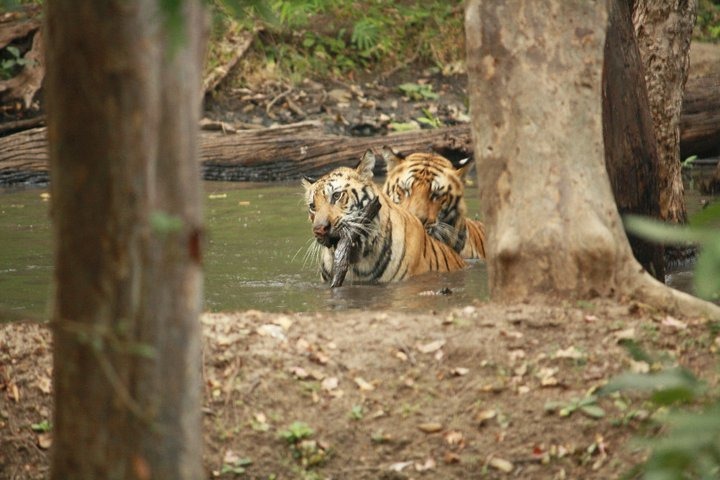
Below Two tigers cool off in a waterhole in Kanha – Photo courtesy of Karan Rana, March 2012


News Courtesy:- Pugdundee News