Despite the erratic rainfall and drying water bodies around the city, there is a silver lining. Ishwaria Lake on the outskirts of Rajkot (Gujarat, India) has literary turned into an oasis for thousands of wetlands birds. Spread over 40 hectares of wasteland at Madharpar village, Ishwaria (Rajkot, Gujarat, India) plays host to thousands of migratory birds from far away places like Siberia and Mongolia in winter and resident birds through out the year. the lake is a major attraction for bird lovers from far and near.
Gujarat in India has varied Bird Sanctuaries and is a paradise for migratory birds
Sunday, May 12, 2013
WORTH Flocking to Thol (Ahmadabad, Gujarat, India)
Paris of Sarus crane beckon bird-lovers.
If you thought, Thol (Ahmadabad, Gujarat, India) was only about migratory birds, another visit to this lake is due!. Flocks of majestic Sarus cranes have descended in the lake and near - by fields. there are at least 50 Sarus cranes here. No wonder then that bird watchers and shutterbugs are flocking to Thol (Ahmadabad, Gujarat, India) these days, braving the blistering heat.Courtesy:- Times of India
Watch towers to deter poachers
Nalsarovar (Ahmadabad, Gujarat) also gets allocation for information network
Now on, the watchful eyes of foresters will be trained on
the winged visitors from overseas that flock to Nalsarovar (Ahmadabad, Gujarat)
every year. The state forest department has decided to set up watchtowers near
the bank of three villages where poachers has been rampant. Officials have also
decided to allocate special funds to set up an information network for
Nalsarovar, a Ramsar site.
Official in Nalsarovar said that at meetings between senior officials
on Monday, it was decided to have watchtowers in three sensitive villages –
Darji, Ranagadh and Vekariya (Gujarat). These have sizeable population and notorious
for the poaching of birds. In all, about 9000 people in these villages hunt and
eat wild animals.
The meeting was held after two people from Ranagadh Village
(Gujarat) were caught with 60 coots that had been trapper and whose legs and
wings were broken to keep them from escaping.
These watchtowers will be equipped with closed circuit
cameras and in order to prevent damage, one hidden camera will also be
installed to catch poachers who will manage to find the visible ones.
Sources in the department said that against the sanctioned
strength of 12, there are just six staffers – including the deputy conservator
of forests and assistant conservator of forests. With just half the sanctioned
strength, officials have to keep watch over 1.5 lakh winged visitors and
thousands of tourists to the wetland spread over 120.82 sq km.
“There are only three guards to secure the highly sensitive
site, which has communities known for poaching living nearby”, said a source. It
was decided at the meeting that staff strength would be increased to ensure
illegal activities are monitored efficiently.
Courtesy:- Times Of India.
Monday, May 6, 2013
Vulture count on a rise thanks to Asiatic Lions
Vulture population may be on a decline across Gujarat but
the number of these fast diminishing scavengers has surprisingly risen in
Bhanvnagar (Gujarat, India) and Amreli districts (Gujarat, India). Interestingly,
it is the lions that are helping these endangered birds make this region their
permanent habitat.
The number of vultures in the 70-km coastal stretch from
Mahua-Rajula-Nageshree (Gujarat, India) has steadily increased from an all time
low of 87 in 2010 to 134 in 2013. In fact, the extremely rare Eurasian Griffon
specie of vultures that were only winter visitors of Mahuva, are now seen throughout
the year.
Besides serious conservation efforts and people’s awareness,
wildlife experts also attribute the increase to the presence of large number of
lions in the revenue land in this region. Vultures feast on the animals that
have been preyed upon by lions.
“Since these lions are out of forests area, they mostly kill
domestic cattle and feed on them in open fields. Moreover, these animals are
untreated and not administered Diclofenac, which is the sole reason for vulture’s
decline. This helps vultures to have a healthy food chain, a critical aspect
for their survival,” said Ruchi Dave, honorary wildlife warden, Bhavnagar
district (Gujarat, India).
Recently, wildlife enthusiasts spotted 25 endangered
vultures including two Eurasian Griffons, feedin on the carcass left behind by
an Asiatic Lion near Rajula in Amreli District (Gujarat, India).
“Few days ago mi spotted eight vultures feasting on an
animal killed by Lions. Such a sight is quite common now”. Said Jasubhai Mobh,
a Maldhari living in Mobh Nesh near Khambha.
Lions are in good numbers in Mahuva, Rajula, Khambha,
Jafrabad and Savarkundla (Gujarat, India) area and most of them are out of
protected forest area. “There are over 75 lions in his 70 km area and most of
them are in revenue area. We have often seen vultures eating the lion’s kill in
these areas,” said Vipul Laheri, honorary wildlife warden, Amreli (Gujarat,
India).
Notably, Bombay Natural History Society (BNHS) has selected
the Mahuva area as one of the six provisional Vultures’ safe Zone on the
country.
Lions’ presence in this ‘vulture’ zone has helped these
birds stay put. “Eurasian Griffon vultures have been observed throughout the
year, which indicated that this area is non-disturbed habitat for vultures,”
Dave said.
Courtesy:- Times of India.
Sunday, April 14, 2013
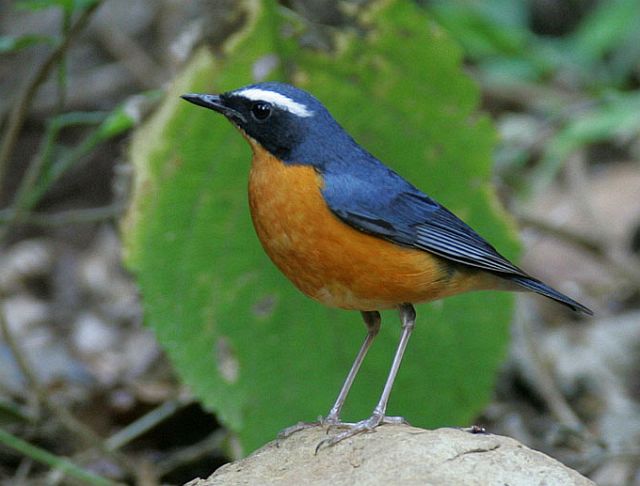
Rare Indian blue Robin spotted in Gir Sanctuary (Gujarat, India)
It was a pleasant surprise for bird watchers Ashok Mashru and his colleagues on Dhuleti when they spotted the rare Indian blue Robin in Girnar Wildlife Sanctuary (Gujarat, India).
According to Mashru, the bird was earlier recorded by renowned ornithologist Lavkumar Kachar in 1996 at Hingolgadh near Jasdan of Rajkot district when it was going to south Indian in autumn.
“It may be possible that Indian blue Robbin, which we spotted, was going back to North India. The species breed in Himalaya. By all chances, this is only the second time that it has been sighted in Guajrat after 18 years,” Mashru said.
Bird watchers say Indian blue Robbin may be a passage migrant. This specie commonly spends winter in hills of Kerala and Sri Lanka.
Courtesy:- Times of India
Saturday, March 30, 2013
For Saurashtrians(Gujarat, India), “lions are like kin”
The people of Saurashtra(Gujarat, India) take care of lions as they would of their family members. If they spot a lion i
n the vicinity of their village, they take pride in the fact and protect it. These statements were made by the government in the assembly for the first time.
Minister of state for forests and environment Govind Patel – in response to a question from Nikol MLA Jagdish Panchal – informed the house that lions were found in many places of India, but they survive only in Gujarat owing to people’s conservation efforts.
“They are the pride of Gujarat and it was only because of the people of Saurashtra that the lion population grew,” Patel said.
“Even if lions attack cattle in villages, the villagers are tolerant of lions”.
Patel told the house that government has also created post of ‘van mitras’ who take care of the animal and keep a watch on the movement inside the sanctuary. He said 898 eco-clubs had been formed in the Saurashtra region.
Responding to a question Patel said that there were 411 lions – 97 males and 162 females – in the sanctuary. He further said that the state had created gene – pool centers. Five new cubs have been born in the last year at the Rampara Virdi centre. These cubs have been born to two pairs of lions captured from completely different areas and brought to Rampara to ensure that the genes different. These centre’s provide a shield against weakening genes of Gir Lions.
For example if the lioness was from Sasan (Gujarat, India), the lion would be from a far off area of Tulsishyam(Jungadh, Gujarat, India) or even Bhavnagar. The minister said that there have been no instances of villagers offering baits to lions in order to show the animals to visitors. However, he admitted that his department had penalized people caught on the spot to the tune of Rs. 93,000 to Rs 31,400.
Courtesy: Times of India.
Friday, March 29, 2013
Of 92 lion deaths in last two years, 83 were natural
No incident of poaching: Government
A total of 92 lions have died in the last two years in Saurashtra region (Gujarat, India). Of these, 83 died natural deaths while the remaining nine died of accidental causes, like falling into open wells.
Minister of state forest and environmental Govind Patel told the House in a written reply to Lathi MLA Bhavku Unghad’s question. The government said that said that 46 lions each died in the year 2011 and 2012. The minister said that among the dead cats were 43 cubs, 20 males, while the rest were females.
The minister said that there was no incident of poaching in the any part of the state. He added that in 2011 five lions lost like in different kinds of incidents, while the number was four in 2012.
The death of 46 animals was normal as only 11 per cent of the animals are dying annually. The officer said that also there was a drop over the past few years in the number of accidental deaths. The forest department has begun a drive to cover up wells in and around Gir Forest (Gujarat, India). However, such incidents of death due to falling in a well were reported in the areas far away from the sanctuary.
The official added that of one looked at the figure more cubs have died recently. A study by Dr. V. Meena of the Wildlife Institute of India titled “Reproductive Strategy and Behavior of Male Asiatic Lions” revealed that survival rate of cubs was lowest in the first year of birth and gradually increases in second and third year, he added.
Courtesy: - Times Of India
Subscribe to:
Posts (Atom)